


A storm swept through Accra on Sunday, 22nd November, 2026 ,but it was no ordinary storm. It was a storm of ideas, inspiration and fresh perspectives on branding. At the heart of it was a compelling question: What truly makes a name worth knowing, valuing and trusting?
This question set the tone for The Brandstorm, a double book launch held on Sunday at the Labadi Beach Hotel in Accra, where renowned marketing scholar Dr. Mrs. Juliana Akushika Andoh unveiled two thought-provoking books that challenge individuals and organisations to rethink how they build their identities, earn trust and create lasting value.
Held under the theme ‘Two Books, One Bold Conversation’, the event at the hotel’s Omanye Hall brought together perspectives from academia, business, public leadership and the creative arts. More than an occasion to unveil new titles, it offered an argument with direct implications for young professionals, entrepreneurs and established companies: a brand is not simply what its owner says it is. It is what others have good reason to believe.
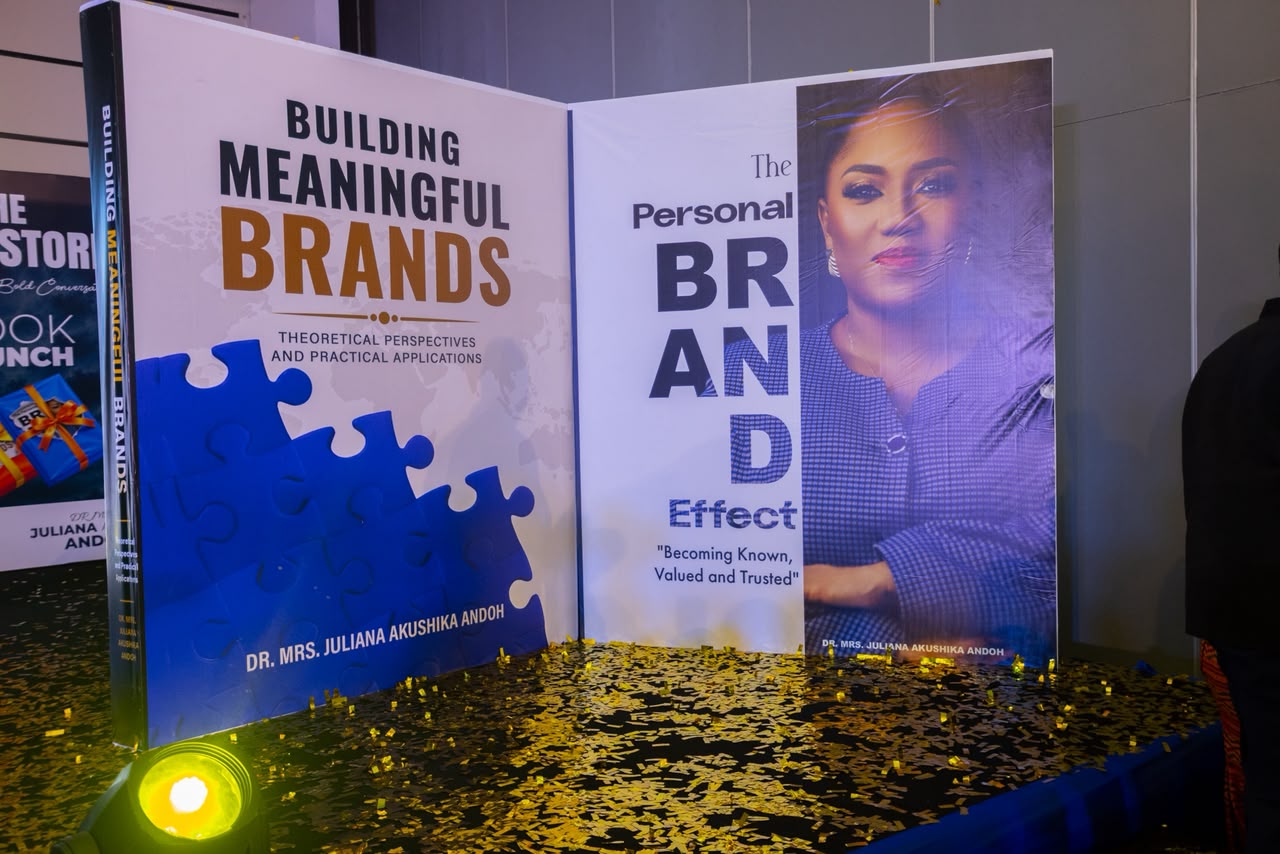
The two books, The Personal Brand Effect: Becoming Known, Valued and Trusted and Building Meaningful Brands: Theoretical Perspectives and Practical Applications, approach that argument from different directions. The first examines the reputation a person builds through identity, competence and conduct. The second explores how organisations develop brands that remain relevant and trustworthy through strategy, customer experience, innovation and responsible growth. Together, they connect the name on a business card with the name on a product label.
For Dr. Akushika Andoh, the journey towards these books has a personal beginning. Reflecting on her professional development, she explained that she did not originally come from a marketing academic background but had practiced it. An opportunity to teach an MPhil class at the University of Ghana became the turning point. Preparing to engage postgraduate students with branding opened her eyes to its wider importance, as a discipline shaping identity, value, relationships and reputation. Dr. Akushika Andoh now serves as a Senior Lecturer and Head of Marketing Department at the University of Professional Studies, Accra.
The event was chaired by the Minister for Trade, Agribusiness and Industry, Elizabeth Ofosu-Adjare, whose address placed branding within Ghana’s wider economic ambitions. Her message linked the strength of Ghanaian exports to the confidence buyers place in the products they receive. Market access may create opportunities for cocoa, shea, textiles, processed foods and other Ghanaian offerings, but international competitiveness also depends on consistency, customer care, quality and a reputation that survives the first sale.
That perspective widened the discussion beyond advertising. As the chairperson’s address emphasised, no memorable campaign can rescue a product that repeatedly disappoints. For businesses seeking opportunities under the African Continental Free Trade Area, the challenge is not merely to enter new markets but to give customers a reason to return. The point was especially relevant to smaller Ghanaian enterprises whose products may be excellent but whose branding, service systems and customer promises have yet to match their ambitions.
The Personal Brand Effect offers a similarly demanding message to individuals. It disputes the popular assumption that personal branding is mainly about appearance, online popularity or self-promotion. Instead, it asks a more searching question: what does a person’s name stand for when that person is absent? A qualification may open a door and a polished profile may attract attention, but it is the quality of one’s work, relationships and decisions that determines whether trust takes root.
Central to the book is Dr. Andoh’s NAME Framework: Nature, Advantage, Message and Evidence. Nature concerns identity and values; Advantage identifies the useful difference a person brings; Message deals with communicating that value clearly; and Evidence insists on proof. This final element gives the framework its force. It moves personal branding away from impressive descriptions towards demonstrable competence, integrity and contribution. For graduates entering a competitive job market, the practical lesson is that being visible is not the same as being valuable.
The book also takes readers through positioning, storytelling, professional presence, digital identity, relationships and reputation management. Its reflections on the traces people leave online are particularly timely, as employers and clients increasingly form first impressions before a meeting takes place. Yet the author does not reduce success to social media mastery. The deeper concern is whether a person’s public image remains consistent with their private conduct, everyday service and capacity to keep learning.
Reviewers listed for the first book brought diverse professional perspectives. They included David Afful, former Managing Director of GB Foods; Kwabena Oppong Nkrumah, Country Manager for Marketing at Betway; Edmund Asamoah, Managing Director of A&C Development; and Jacqueline Afful, Managing Director of Appointed Time Printing. Their experience showed why professional credibility matters far beyond the classroom.
The second book shifts the spotlight from people to enterprises. Across 16 chapters arranged in four parts, Building Meaningful Brands examines brand foundations, positioning, customer journeys, organisational culture, expansion, innovation, sustainability and the future of branding. It explains why a strong logo and an attractive slogan cannot substitute for clear strategy. Customers ultimately judge a brand through the product they receive, the service they experience and the way an organisation behaves when something goes wrong.
One of its most practical arguments is that branding is everybody’s responsibility. A marketing team may promise excellence, but that promise is tested by a receptionist, a delivery driver, a branch officer or a complaint-handling desk. A restaurant with beautiful photographs but poor service illustrates the problem: attention can bring customers through the door, while only a consistently good experience persuades them to return. For organisations, the book effectively turns branding into a leadership and operational discipline.
Its later chapters are equally concerned with what happens after success. How should a growing company organise several products without confusing customers? When does innovation strengthen a brand and when does it stretch the brand beyond recognition? What should an honest brand audit reveal? The discussion extends to ethical business, African market realities, artificial intelligence and growing expectations of transparency. The underlying standard remains constant: what an organisation claims must be supported by what it does.

Professor Bedman Narteh of the University of Ghana Business School presented the foreword during the launch programme, while Mrs. Aba Lokko was listed to review the second book. The programme also featured Kafui Dey as master of ceremonies, a spoken word performance by Nana Asaase and a musical contribution by Mrs. Dede Akaba and Kwabena Kwabena. These elements gave the afternoon a wider cultural frame, connecting the rigour of the books to the stories, language and public conversations through which reputations are formed.
The guest profile also included industrial development and investment promotion specialist Eugene Tettey Sangmortey, reflecting the relevance of the discussion to business growth and national competitiveness. The formal unveiling of both books and the ceremonial first purchase formed the centrepiece of the celebration, followed by goodwill messages and an opportunity for book signing, photographs and networking. But the lasting significance of the gathering lies less in the ceremony than in the questions its publications leave with readers.
That is the enduring appeal of Dr. Andoh’s two books. They do not offer branding as a shortcut to fame or a cosmetic solution to business problems. They present it as a long-term responsibility to create value and earn confidence. Anyone who has wondered why some names are remembered, why customers return to certain businesses or why others fade despite enormous publicity will find reason to seek out these books. The Brandstorm may have lasted an afternoon; its most important conversation begins when readers turn the pages.

